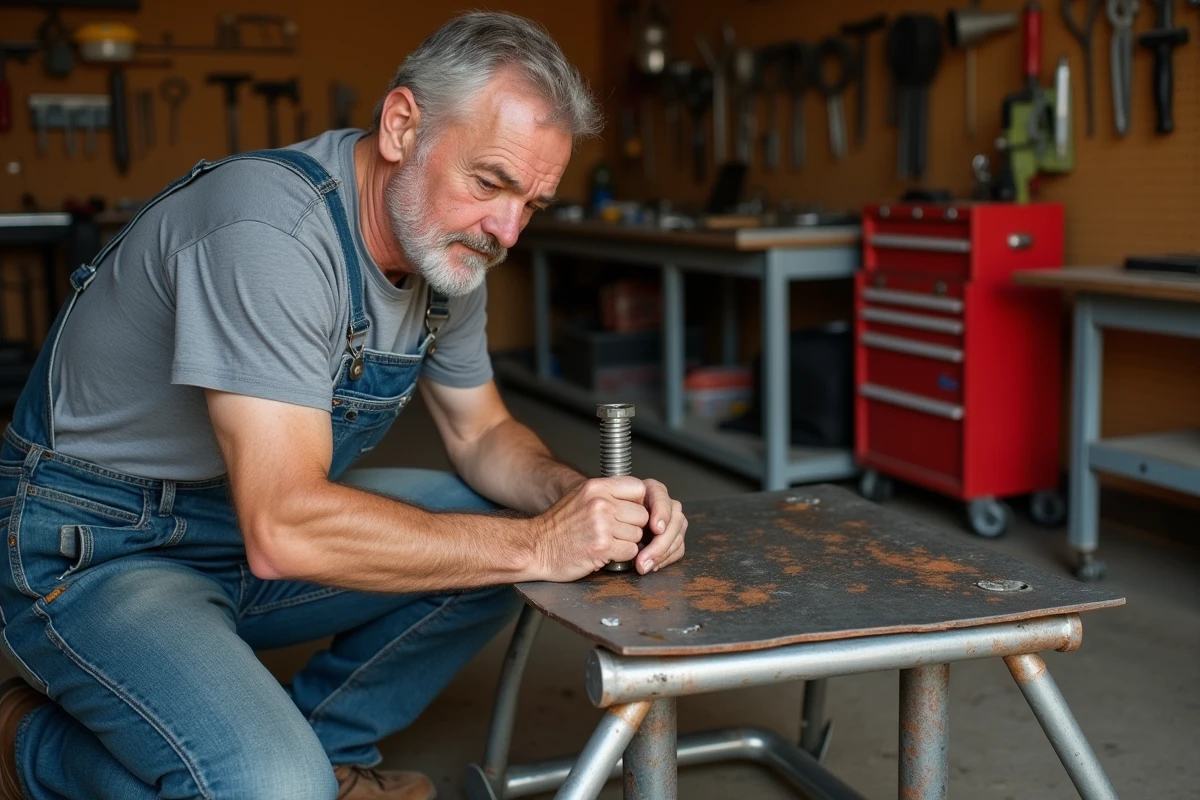
Changing a blade, cleaning a housing, or checking a belt under a lawn tractor requires lifting it in a stable manner. Making a DIY lawn tractor lift remains an economical and adaptable option, provided that a few construction principles are followed to ensure safety throughout the handling.
Lateral Stability and Lithium-Ion Battery Lawn Tractors
Lithium-ion battery lawn tractors pose a problem that traditional gas models do not. The battery pack, often housed under the seat or in the chassis, concentrates a significant mass at a low and off-center point. The result: the center of gravity is lower but also less symmetrical.
On a homemade lift using a simple hydraulic jack and two wedges, this imbalance results in lateral tipping as soon as the tilt exceeds a few degrees. Battery models often far exceed the load threshold of the screw lawn mower lifts sold in stores.
Have you noticed that your tractor leans slightly to one side when parked on flat ground? It’s the battery that pulls it. To compensate, the lift’s structure must incorporate two independent and adjustable lateral support points. Two steel brackets welded to the base frame, spaced at least the width of the chassis apart, stabilize the whole much better than a single central rail.
If you are building a homemade lawn tractor lift for a heavy machine, plan for a rectangular steel tube frame rather than angle iron. Rectangular tubing resists twisting better, which limits the risk of deformation under asymmetric load.
Material Selection and Frame Sizing
The base material dictates everything else. A wooden frame works for light mowers, but it deforms with moisture and ages poorly in an unheated garage.
Steel or Wood: Decide Based on the Machine’s Weight
For a standard gas lawn tractor, a 40 x 40 mm steel tube with a thickness of 3 mm is more than sufficient. For a heavier battery model, switch to 50 x 50 mm or 60 x 40 mm. Arc welding with standard rutile rods is suitable, provided that the tubes are well cleaned before assembly.
Wood is only acceptable for machines weighing less than 150 kg. Beyond that, screwed joints work under load and eventually become loose. A mixed frame (solid wood reinforced by steel plates at the joints) represents a compromise, but full welding remains more reliable.
The Ramp or the Platform: Two Different Concepts
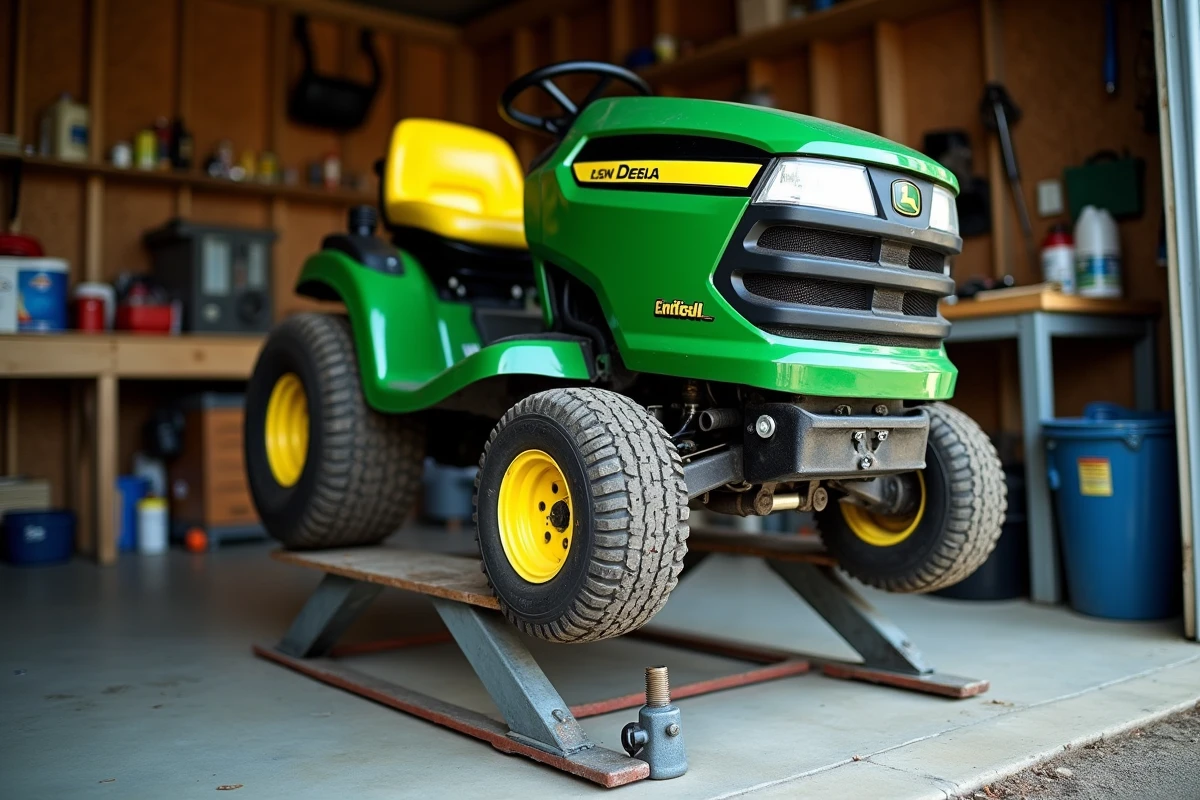
The inclined ramp involves rolling the tractor onto a sloped plane, with the front wheels elevated compared to the rear wheels. The vertical lift platform raises the entire machine horizontally using a jack or a cylinder.
- The ramp is simpler to make: two steel rails, a welded stop at the top, and the tractor climbs by its own means. It is sufficient for accessing the cutting deck and blades.
- The platform provides complete access under the machine, including the transmission and wheels. It requires a hydraulic jack or a cylinder, and a stiffer frame.
- For a heavy battery tractor, the platform with a cylinder is the only truly stable option because it maintains a horizontal position and distributes the load over four supports.
Safety During Lifting and Maintenance
Lifting is the riskiest phase. A tipping lawn tractor can crush a foot or hand in a fraction of a second.
Never work under the machine with the jack as the only support. Once the desired height is reached, always secure with mechanical jack stands or steel blocks. The jack is used to lift, the stands are used to hold.
Before each lift, check three points:
- The ground must be hard and flat. Concrete is ideal. Grass or gravel deform under load and cause gradual slipping.
- The tractor’s parking brake must be engaged, and the wheels blocked on both sides with wooden or rubber wedges.
- If the tractor is battery-powered, disconnect the safety plug or remove the key before any intervention under the chassis, even for simple cleaning.
Simplified Construction Plan for a Ramp Lift
Here is a straightforward approach for a ramp lift suitable for standard-sized gas lawn tractors.
Necessary Parts
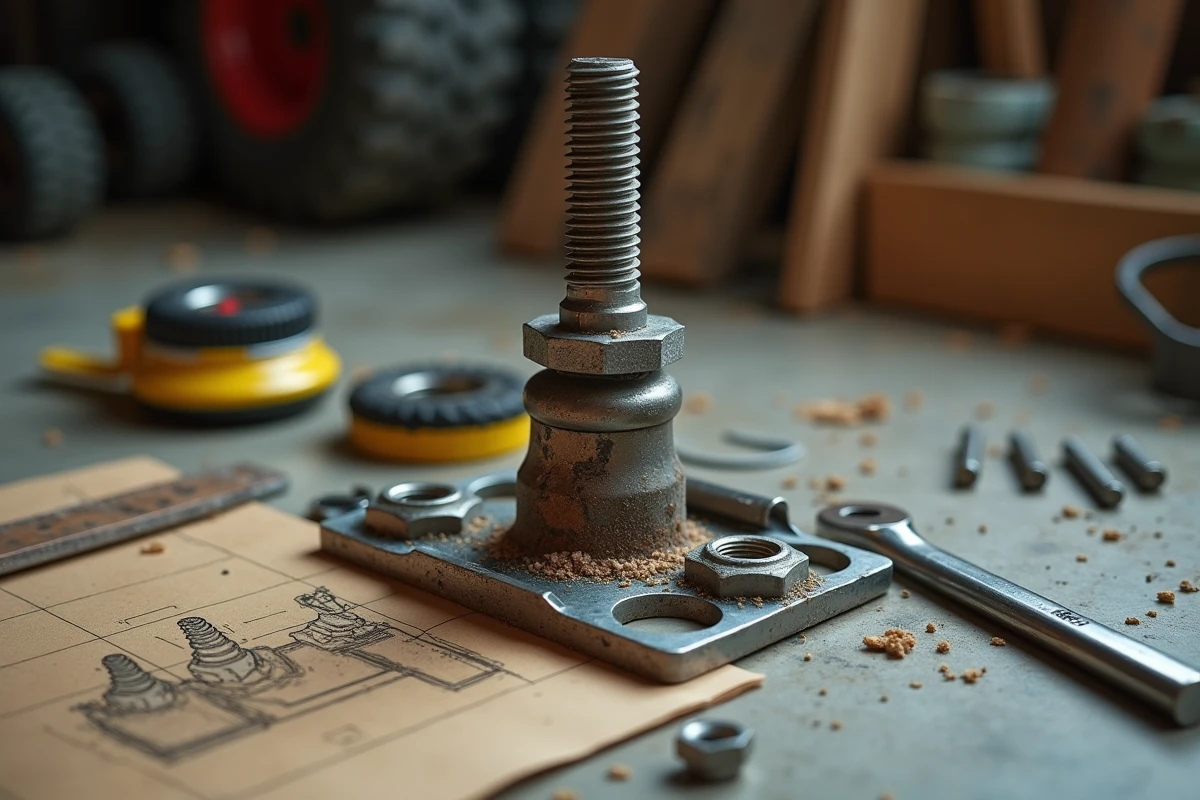
Two rectangular steel tubes for the rails (approximately 1.20 m long each), four square tube legs to elevate the high end, a welded rear crossbar between the two rails, and a stop made of angle iron fixed at the top of each rail to block the wheels.
Assembly
The two rails are placed parallel, spaced apart by the width between the tractor’s wheels. The rear legs elevate the high end. The crossbar connects the two rails at the top to prevent spreading under load. The angle of the ramp should not exceed 20 to 25 degrees to allow the tractor to ascend without slipping.
Once the tractor is at the top of the ramp, the front wheels rest on the stops. You can access the cutting deck from underneath without having to slide under the entire machine.
For a battery model exceeding the weight of standard gas models, this type of ramp quickly shows its limits. The load concentrated on the two rails can cause bending. In this case, add a third central rail or switch directly to a platform with adjustable supports, as described above.
The manufacturing time for a basic ramp is around an afternoon, including welding equipment. Check each weld before the first load test by tapping it with a hammer: a good weld sounds solid, a hollow or cracked weld sounds hollow and must be redone.