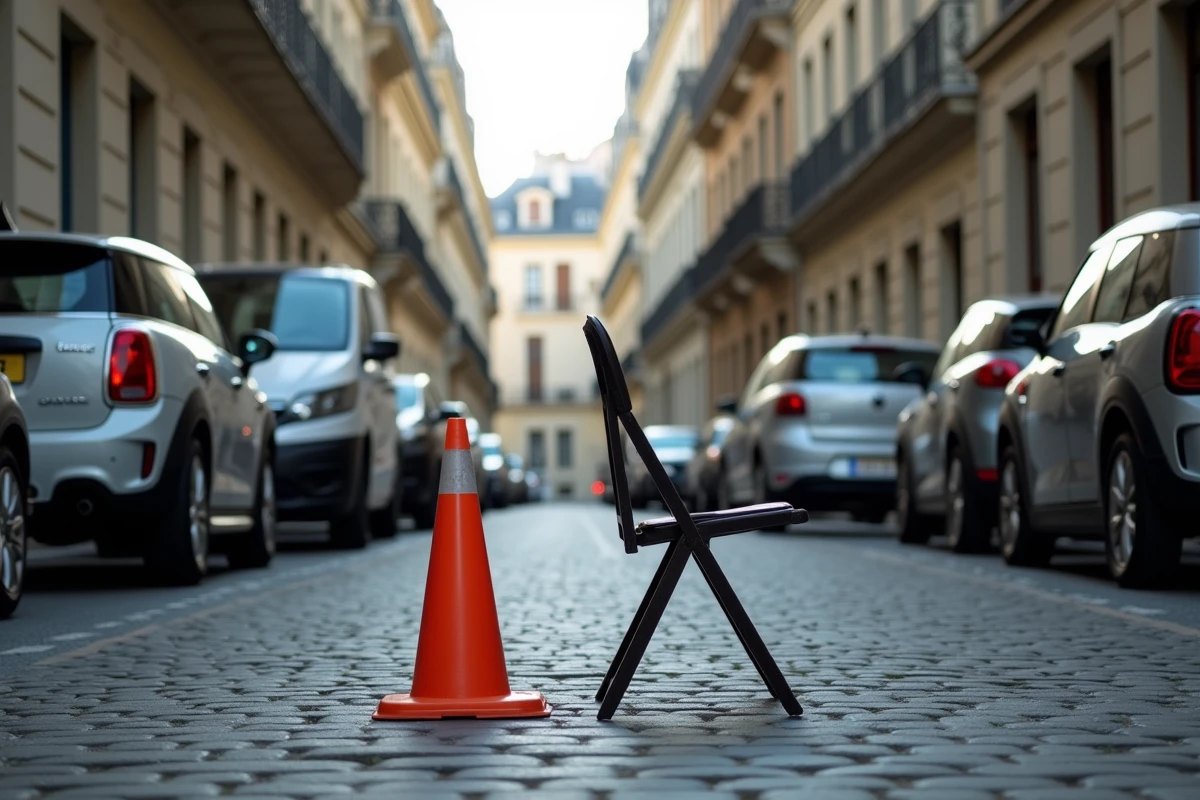
An orange plastic cone placed at the edge of the sidewalk, two garden chairs lined up on the pavement, a flower pot strategically placed in front of the house: we have all come across these makeshift devices to keep “one’s” parking space. The instinct is understandable, especially when living on a street where finding a spot is like an obstacle course.
The legal response is unequivocal: no one can reserve a space on public roads with a personal object, even in front of their own door.
Cone in front of a garage, on the sidewalk or in a private street: the concrete risks vary
The first thing to establish is the status of the space where the object is placed. This detail changes everything, from the amount of the fine to who can intervene.
On a public road (municipal street, sidewalk, non-private parking), the roadway belongs to the public domain. Placing a cone, a trash can, or a barrier without permission constitutes illegal occupation of the public domain. This is the same offense as setting up a commercial stall without permission.
In front of a garage, the situation becomes more complicated. If access to the garage is marked by a drop curb (lowered sidewalk), the highway code already prohibits anyone from parking in front of it. Therefore, the owner does not need to place a cone to protect access; they can report the violation. However, installing a fixed cone on the roadway to “reinforce” this prohibition remains prohibited without municipal authorization.

In a private street, the rules change. If the road belongs to a private owner or a co-ownership, the internal regulations apply. The owner of the private street can, in theory, allow or prohibit the placement of objects.
Some private streets remain open to public traffic and then fall under the regime of a classic public road. As explained by the blog Ma Maison Idéale, the confusion between an open private road and a truly privatized road traps many residents.
Temporary occupation permit: the only legal way to reserve a space
It is often believed that a move or facade work justifies placing two cones “for a few hours.” In practice, even a short-term occupation requires an administrative framework.
The process involves requesting a temporary occupation permit for the public domain from the town hall. Depending on the municipalities, this is referred to as a parking permit or a road order. The principle is the same: the town hall issues a document that authorizes the installation of temporary signage, sometimes supplemented by cones or barriers provided by the road service.
- The application deadline varies from one city to another, but it generally needs to be done at least one to two weeks before the planned date.
- The request specifies the exact location, dates, times, and nature of the occupation (moving, delivery of materials, construction dumpster).
- Some municipalities charge for this occupation. The fee depends on the area occupied and the duration.
- The regulatory signage (no parking signs with dates) is often installed by the municipal services themselves.
Without this order, the reservation has no legal value. A driver who moves your cones to park does not commit any offense. You are the one at fault.
Sanctions and removal: what happens when the town hall intervenes
A resident who places an object on public roads without authorization faces several consequences, depending on the reaction of the municipality and neighbors.
The most common scenario remains a report to the road service or the municipal police. An officer may issue a ticket for illegal occupation of the public domain. The fine is generally a fixed penalty, which may be supplemented by the cost of removing the object if the municipality calls in a team.
In case of recidivism or significant obstruction of traffic, the situation can escalate. It goes from a simple warning to a report sent to the police court. The judge may impose a higher fine and order the restoration of the premises at the offender’s expense.
The other risk, less legal but very real, concerns the neighborhood. Placing a “home” cone strains relationships. Parking conflicts are among the most common causes of tensions between neighbors in densely populated urban areas. A note slipped into the mailbox can quickly turn into a prolonged dispute.
What if someone moves or breaks the placed object?
A passerby or driver who pushes your cone to park commits neither theft nor damage in the legal sense, since the object was not intended to occupy that space. However, if the object causes an accident (a pedestrian falling on a poorly visible flower pot, damage to a vehicle), the civil liability of the resident who placed it may be engaged.
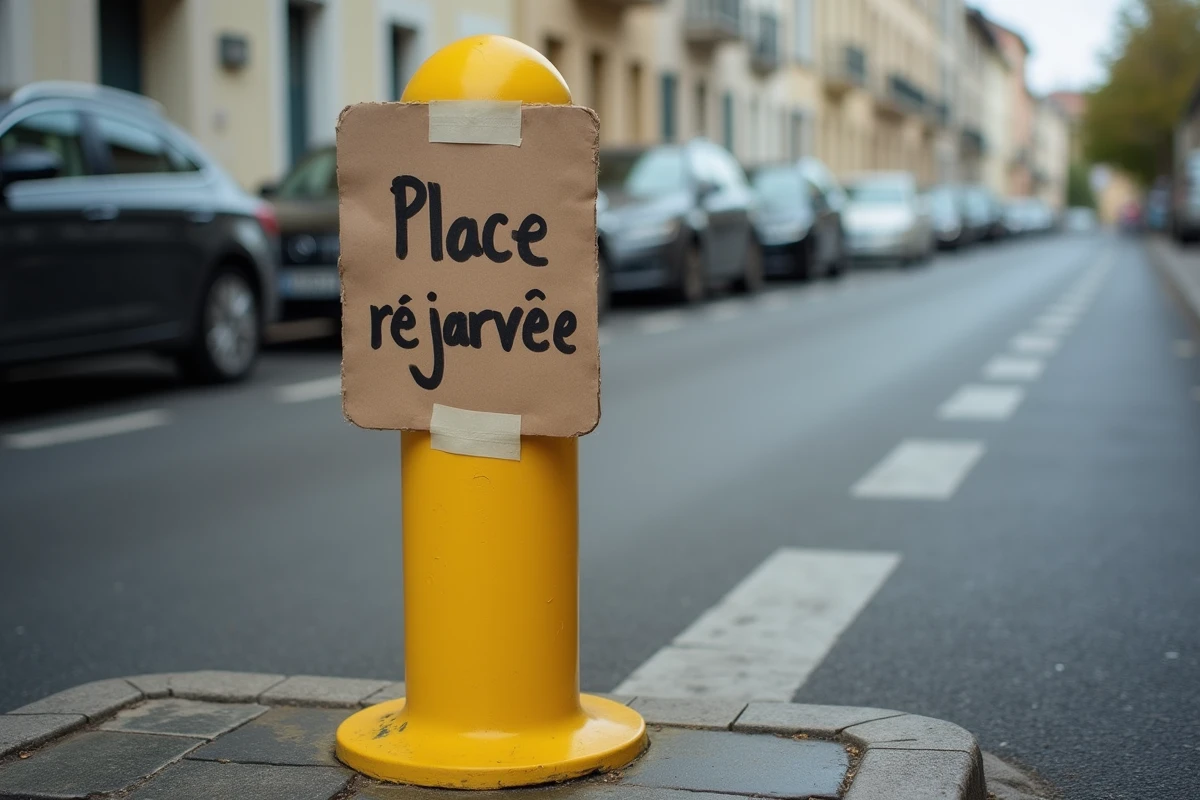
Parking in front of one’s home: concrete alternatives to wild cones
Rather than risking a fine and a neighborhood conflict, several solutions exist to secure access or facilitate a move.
- Request a municipal order for temporary parking reservation, as described above. This is the only method that provides a framework enforceable against third parties.
- Install an approved anti-parking device in front of a garage (foldable hoop, for example), after obtaining the town hall’s agreement. This type of bollard is tolerated in some municipalities, provided it does not extend onto the sidewalk.
- Report vehicles in violation in front of a drop curb or pedestrian crossing to the municipal police, rather than trying to take justice into your own hands.
The instinct to use a cone or chair remains ingrained in habits, but it offers no legal protection. Only a municipal order transforms a public space into a temporarily reserved spot. Everything else exposes the resident to a fine, the confiscation of their object, and sometimes a bill for restoration.